Kyoto's maples and Hokkaido's powder arrive within weeks of each other. Here is how to enjoy both in one graceful journey, with the hotels that make it special.
Japan has a gift for seasons. In autumn the maples of Kyoto turn the color of lacquer and persimmon; by midwinter the mountains of Hokkaido lie under some of the softest snow on earth. For travelers who plan with intention, these two moments make the most rewarding window of the Japanese year.
The world has noticed. Japan welcomed 42,683,600 international visitors in 2025, a record and a 15.8% rise on the year before, according to Japan National Tourism Organization (JNTO) figures. Arrivals from the United States reached 3,306,800, up 21.4%. The secret is out, which makes the way you travel there matter more than ever.
A Country Travelers Keep Choosing
The appetite shows no sign of fading. JNTO data reported in October 2026 put arrivals for January through September 2026 at roughly 30.7 million. In September alone, travelers from South Korea, Taiwan, Singapore, India and Mexico arrived in record numbers for the month.
For the luxury traveler, that popularity is good news. It has encouraged a generation of exceptional small hotels, refined ryokan and mountain retreats that reward those who book early and travel at a gentle pace. The best of them are intimate by design, often with only a few dozen rooms.
Kyoto: Autumn Color and Winter Calm
The Art of Momiji
Kyoto's autumn foliage, known as momiji, is one of the great natural spectacles of Asia. Color usually builds through November, with the city's best viewing often arriving from late November. In the Arashiyama district on the western edge of the city, the peak season typically runs from mid-November to early December.
A few places define the season:
- Tofukuji Temple, where the wooden Tsutenkyo Bridge looks over a valley of maples.
- Eikando Temple, with its tea house and a tunnel of crimson leaves.
- Nanzenji Temple, where maples frame the great Sanmon Gate and the brick aqueduct.
- Kiyomizudera, whose wooden stage floats above a hillside of autumn color.
The insider's approach is simple: go early. The first hour after the temple gates open brings soft light, cool air and a quiet that feels centuries old. Spend the middle of the day on a long kaiseki lunch, then return to the gardens as the evening light warms the leaves.
Arriving by Boat: The Ryokan Experience
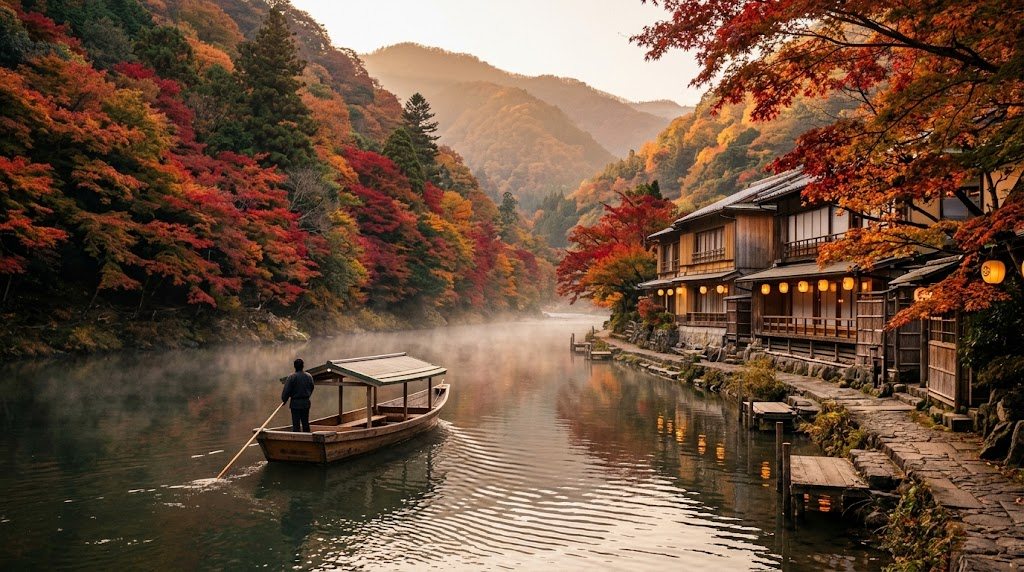
Few hotel arrivals anywhere match HOSHINOYA Kyoto. Guests board a boat on the Oi River and glide upstream to a riverside retreat in Arashiyama, leaving the city behind with every bend. The property has just 25 rooms, each with a view of the river.
That scale is the essence of the ryokan tradition. A great ryokan is less a hotel than a performance of hospitality: a multi-course kaiseki dinner built around the season, a deep soaking bath, futon laid out while you dine and a staff that seems to anticipate each wish. In autumn, HOSHINOYA Kyoto has offered private boat outings on the river to view the foliage from the water, a gentle way to see Arashiyama at its most beautiful.
A night or two in a ryokan pairs well with a stay at a contemporary Kyoto hotel. The contrast deepens the appreciation of both: one shows you the city, the other shows you its soul.
Niseko in Winter: Powder With a View
As the leaves fall in Kyoto, the snow begins in Hokkaido. Niseko, on Japan's northernmost main island, has built a global following among skiers for its light, dry powder. The Niseko United ski area offers 2,191 acres of skiable terrain plus access to backcountry skiing.
The standout luxury address is Higashiyama Niseko Village, a Ritz-Carlton Reserve, which opened in December 2020 as the brand's debut in Japan. It has 50 rooms and suites, many framed by Mount Yotei, often called the "Mount Fuji of Hokkaido," and by Mount Niseko Annupuri. A traditional onsen, fed by mineral-rich water from natural underground hot springs, waits at the end of each ski day.
Dining is part of the draw. Yukibana celebrates seasonal Hokkaido produce, Sushi Nagi serves omakase and Ume Lounge pours cocktails, single malts and local beers alongside izakaya-style plates. After a morning in the trees and an afternoon in the onsen, few evenings feel more complete.
The Flavors of the Season
Japanese cuisine follows the calendar with devotion, and late autumn and winter are among its richest chapters. In Kyoto, kaiseki menus shift toward chestnuts, matsutake mushrooms, persimmons and delicate yuba, often served on lacquerware chosen to echo the colors outside the window.
Hokkaido answers with the bounty of cold northern waters. Winter brings snow crab, sea urchin, scallops and salmon roe, along with the island's celebrated dairy and potatoes. A simple bowl of miso ramen after a day on the slopes can feel as memorable as an omakase counter.
Three ways to eat well on this journey:
- Reserve one kaiseki dinner in Kyoto and let the chef guide the evening.
- Visit Nishiki Market in the morning for pickles, tea and seasonal sweets.
- Sit at a sushi counter in Hokkaido, where the seafood arrives remarkably fresh.
Sake deserves a place too. Kyoto's Fushimi district has a long brewing tradition, and a guided tasting adds a graceful afternoon to any itinerary.
Kyoto in Winter: The Quiet Season
Many travelers know Kyoto for its maples and cherry blossoms. Fewer discover its winter character, which may be the city at its most contemplative. The air is crisp, the light is clear and the stone gardens of the great Zen temples feel especially serene.
On the rare mornings when snow dusts the city, the golden pavilion of Kinkakuji and the moss gardens of the northern hills become scenes from a woodblock print. Even without snow, winter is an elegant time for tea ceremonies, private garden visits and long soaks in a ryokan bath.
Designing One Journey Across Two Seasons
The most rewarding itineraries link both experiences. A traveler can begin in Kyoto at the tail of the foliage season in early December, then fly north to Hokkaido as the ski season gathers pace. Alternatively, a winter trip can open with a few days of quiet temple visits in Kyoto, when the city is calmer and the gardens wear a frost of their own.
A well-paced two-week journey might look like this:
- Days 1 to 3: Tokyo, for food, design and a first taste of Japanese hospitality.
- Days 4 to 7: Kyoto, with two nights in a city hotel and two in a ryokan.
- Days 8 to 13: Niseko, for powder mornings, onsen afternoons and long dinners.
- Day 14: A final night in Tokyo or a direct departure from Hokkaido.
Rail travel adds its own pleasure. The shinkansen between Tokyo and Kyoto is a highlight in itself, with Mount Fuji visible on a clear day.
Planning your Japan journey
Japan's record popularity is a sign of how much it offers, and the most memorable trips go to those who plan with care. Book the smallest properties first, since a 25-room ryokan or a 50-room mountain resort fills quickly in peak weeks. Build in unhurried mornings for the temples and leave room for a long dinner every night.
Above all, travel with the seasons in mind. Autumn in Kyoto and winter in Niseko are two of the finest expressions of Japanese beauty, and they sit close enough on the calendar to enjoy in a single, unforgettable journey.
Sources
- Travel Voice (citing JNTO), "International arrivals in Japan exceeded 42 million in 2025, 10 million more than 2019," January 2026.
- Travel Voice (citing JNTO), September 2026 international arrivals report, October 21, 2026.
- Japan National Tourism Organization, "US Tourism to Japan Continues to Shatter Records," June 3, 2025.
- MATCHA, "Chasing Autumn Colors: Elegant Hotels Near Fall Foliage Spots" (HOSHINOYA Kyoto), October 2023.
- japan-guide.com, "Kyoto: Starting to Change," autumn color report, November 14, 2023.
- Marriott International, "Higashiyama Niseko Village, A Ritz-Carlton Reserve Opens in Japan's Legendary Winter Wonderland," December 17, 2020.